Indicators of Global Climate Change 2025: annual update of key indicators of the state of the climate system and human influence
11 June 2026
An international group of researchers has produced a fourth update to key indicators of the state of the climate system set out in the IPCC AR6 assessment, building on previous editions in 2023, 2024 and 2025.
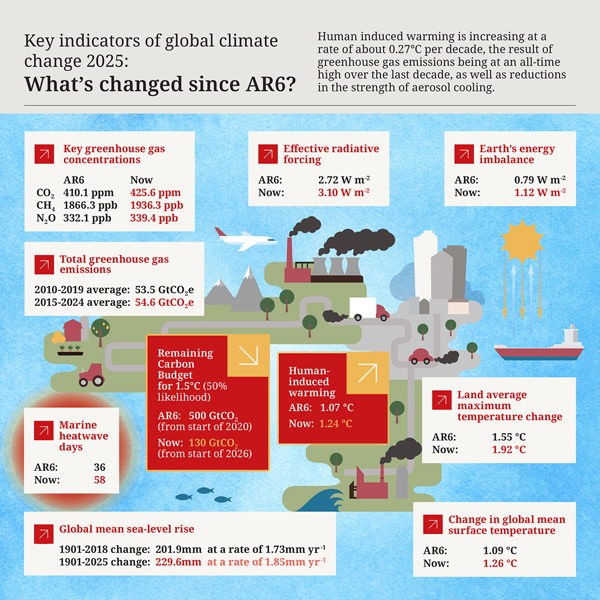
Forster et al. (2026) assess emissions, concentrations, temperatures, energy transfers, radiation balances, and the role of human activity and conclude that the entire climate system is continuing to heat, driving rapid global warming. Human activities pushed global warming to 1.37°C in 2025, and it is projected to surpass 1.5°C in about four years. Crucially, the rate at which heat is accumulating in the Earth system also suggests high levels of future warming.
This year's update also included an additional indicator of climate and weather extremes, marine heatwave days. Marine heatwaves are becoming more frequent, consistent with the ongoing warming of the ocean surface. The number of days experiencing marine heatwaves has more than tripled globally between 1991 and 2025. 2025 alone experienced 65 days of marine heatwaves.
Other key findings include:
- Global greenhouse gas (GHG) emissions are at an all-time high, reaching 56.8 billion tonnes (gigatonnes or Gt) of carbon dioxide equivalent emissions (CO2e) in 2024 (the most recent year for which data is available), mainly from the burning of fossil fuels.
- Atmospheric GHG concentrations reached 425.6 parts per million (ppm) for carbon dioxide (CO2), 1936.3 parts per billion (ppb) for methane (CH4) and 339.4 ppb for nitrous oxide (N2O) in 2025. Concentrations of all three major GHGs have increased since 2019, with CO2 increasing by 15.6 ppm, CH4 by 70.0 ppb, and N2O by 7.2 ppb between 2019 and 2025.
- The rapid warming over the last few decades has resulted in record extreme temperatures over land. Land average maximum temperatures for any single day in a year reached 1.92°C over the last decade (2016–2025), an increase of 0.49°C compared to 2006–2015.
- In 2025, global sea level rise reached a new record of 23 cm since 1901. Sea levels are rising at a rate of around 1.8 mm per year, and this rate is speeding up fast.
IGCC is also working with the European Centre for Medium-Range Weather Forecasts (ECMWF) to develop a user-friendly platform for tracking, visualizing and understanding these indicators. The platform will be available at this link from 11 June 2026: https://indicators.climate.copernicus.eu/
Publication of this up-to-date, openly accessible data, which adheres closely to IPCC methodologies, provides a means of tracking and monitoring human influence on climate in between the publication of IPCC reports.
Contact: Piers M. Forster (p.m.forster@leeds.ac.uk)